Estes Park Talk

We got to the Stanley Hotel around noon on Sat...

The Stanley Hotel (from Wikipedia)

It occurs to me that some definitions may be in order.  As in a great many places, those who live in Estes Park have their own way of saying things.  Since everyone here, including the elk, came here from somewhere else, we are possibly even more fiercely partisan about our town than people are who have been born in theirs.  So here are a few names and definitions:

Estes — What we call our town when we’re not being formal.  As in, to a summer resident:  “When did you get back to Estes?”

ParkRocky Mountain National Park, for which Estes is one of two primary gateways.  Sample statement:  “Let’s take a drive around the Park.”  Also called “Rocky” or, less often, “RMNP.”  I also call it “my big back yard.”  To see a map, please Google maps and specify “RMNP.”

Around the Park — Does not mean literally “around the Park,” which would be a very long hike.  Instead, it means a paved road of about eight or so miles from the Moraine Park entrance up to Deer Ridge Junction, then back down to the Fall River entrance.  Sometimes, this includes a side journey to Bear Lake.  Takes about a half hour, unless you stop and watch the elk cavort or happen to spy a bighorn sheep.

Locals — People who live for either part of the year or all year in the Estes valley.  Sometimes includes residents of Glen Haven (a small mountain community down a picturesque canyon), but does not include residents of Allenspark (a small mountain community up a very picturesque drive called the Peak to Peak Highway, otherwise known as Highway 7).  (Allenspark residents have a beautiful town and are very proud of it.  Also, by definition they do not live in the Estes valley (see below).)  Also a local restaurant.

Elkjam — Local term for the traffic jam that happens instantaneously whenever a car (all right, its occupants) spies an elk or an elk herd close to the road or crossing the road.  That car stops to take pictures and immediately, as if by magic, at least 25 other cars also stop, often in the road rather than on the verge, to take pictures of the elk doing what they do, which is mostly eat and stop traffic.  Those interested in seeing this (locals get very tired of it, actually, not the elk but the cars) should search for “elkjam” on YouTube.  There is at least one news feature about the phenomenon nearly every year.

Estes valley — What residents call the entire valley enclosed by mountains which encompasses Estes Park, with the continental divide to the West, Lumpy Ridge to the north, and lower mountains leading down to the valley.  As a local, I stake my claim that this is the most beautiful mountain valley on earth.

Valley — Term used by all locals (see above) and other mountain people to refer to the area of the United States between the Rocky Mountains and the Appalachian Mountains.  As in, “I’m going to the valley to shop today.”  (In this case, the speaker actually means Ft. Collins, Loveland, Longmont, Boulder or, less likely, Denver.)

The Stanley — The Stanley  Hotel, built by F.O. Stanley (of Stanley Steamer fame) in the early 20th Century as a resort hotel in NeoColonial style.  In order to build it, Mr. Stanley also had to create a hydroelectric plant, a sewage plant and a sawmill.  He also had to greatly improve the roads up to Estes Park from the valley (see above) so they could be used by his own Stanley Steamers to bring tourists to his hotel.  In doing so, he practically created the modern town of Estes Park and its primary industry, tourism.  The Stanley Hotel was a primary inspiration for Stephen King’s novel “The Shining” and his own television production “The Shining” was shot on location there.  It is most definitely haunted.  A picture of the Stanley is at the top of this post.

Fairgrounds — Actually and precisely, Stanley Park, which contains the arena, quite a few horse barns, and space for tents, booths, and so forth.  This is the venue for many summer activities, including the Rooftop Rodeo, the Hunter-Jumper show, the Scottish-Irish Heritage Festival and others.  Called the “fairgrounds” only by locals (see above), thus confusing all visitors because all the signs say “Stanley Park.”

The Bypass — Another confusing term.  Locals call this road the bypass because it does that, i.e., it bypasses downtown Estes Park.  All the signs, however, say Wonderview Avenue.  Which it also is; i.e., a wondrous view.

Longs — Local term for our tallest and most prominent mountain peak, Long’s Peak, discovered by an Army gentleman named, oddly enough, Long.  Of course, “discovered” is a relative term, since the Arapaho and Shoshoni tribes always knew it was there.  “Longs” is not to be confused with “Pikes”, which is another famous Colorado mountain peak west of Colorado Springs.  Longs, by the way, is several hundred feet higher than Pikes.  Sample statement:  “Are you planning on climbing Longs this year?”  (My answer is an immediate “no, I plan on looking at Longs this year,” as it always is.)  One of my own photos of Longs is published at the bottom of this post.

Elkhorn — Our main street, named (probably) for the Elkhorn Lodge, one of our oldest still-standing structures, a resort, tourist lodge and dude ranch that is now considered one of the six most endangered historical structures in the state of Colorado.  It should be noted that elk actually do not have horns, they have antlers.  Antlers are shed each year, while horns (see bighorn sheep, above) are permanent and grow incrementally each year.

Dunraven — Now primarily an exceedingly good and long-lived Italian (and seafood) restaurant out on Moraine.  However, in the 19th Century, the Earl of Dunraven (yes, a real British (okay, Welsh, I think) belted earl and no, I don’t know why earls would be more belted than, say, barons or even bankers), falling in love (as so many have since) with the Estes valley, decided ownership was the only possible course.  He spent years more or less bribing more or less unsavory types to “homestead,” after which he would buy the homesteaded land.  Theoretically at that time, one was only allowed to homestead 160 (I’m not looking this stuff up, so anybody out there reading this who begs to differ is probably right and I would love to hear the, well, facts) acres of government land, which the Estes valley was considered to be.  He planned on making the place his own private hunting reserve and to this end built a hotel, the first in town, I believe, for his friends.  (He also, with his friends and with the help of other tourists and hunters, killed off all the local elk population.  The big elk herds that have taken over the town now were originally imported in the 20th Century from Wyoming.)  The State of Colorado and the United States Government took issue with his version of “homesteading” and worked in the courts to break up his holdings, finally managing to annoy him enough that he left, never to return.  F.O. Stanley (above) bought quite a bit of his land for the Stanley Hotel.  However, statements that the Earl of Dunraven haunts the third floor are a bit strange, since the Earl left Estes years before the hotel was built.
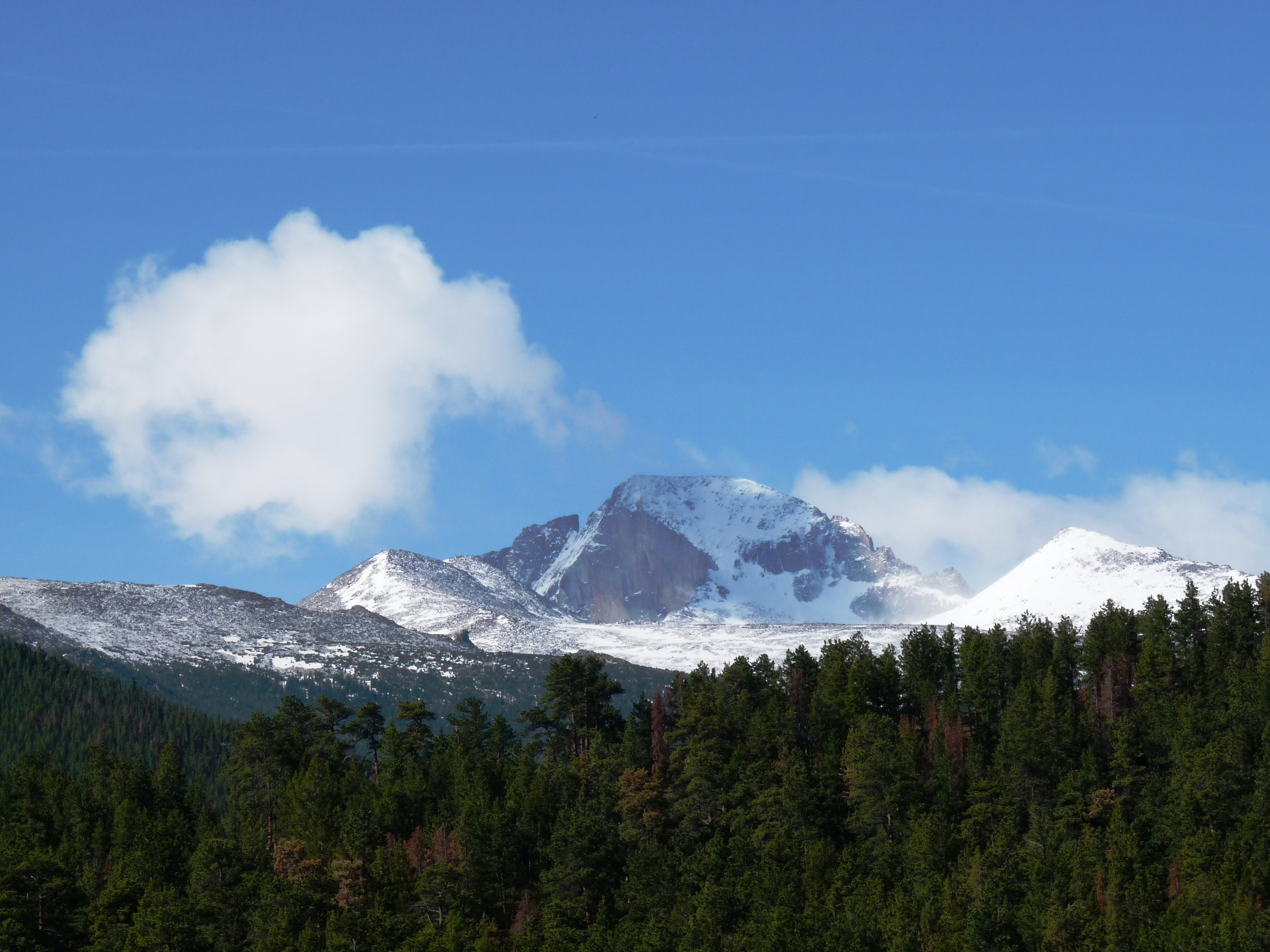
Long's Peak

Snow Day

Snuggle time, making soup time, looking out at the world and being glad you’re inside time.  Obviously, I’m an indoor girl.  Didn’t used to be — of course, once dressed in snowpants, boots, mittens, sweaters, parka, hood, about the only thing I could do outside during or after a snow was to make snow angels, and then I could hardly get back up.  But I loved to look up and try to catch snowflakes in my mouth, let them melt on my tongue.  Such a clear, cold taste.

Snow crystals 2b

Image via Wikipedia

And after the snow, when it would get cold and crisp, walking on the snow made a scrunching sound unlike any other sound I’ve ever heard.  I was a child in Greeley, Colorado, and often after a snow would come a hard freeze which would leave a crust on the snow that, at the time, I was small enough to walk on if I was careful.  I would try for the longest series of steps possible before breaking through the snow crust.  Of course, I eventually would, and that usually would mean I would fall down, but falling down on a foot of snow when you’re eight years old and washing your face with snow is fun, not any kind of problem.

But as I grew up, snow got to be a problem at times.  Sometimes more than a problem.  How was it that it always snowed on Sunday night, thus making sleep impossible because I would worry so over the commute to work?  Especially the first snow.  It is a tradition in Denver, it seems, to have a first snow in October.  Coloradans and Denverites are never ready for it and seem to have forgotten how to drive in the stuff over the summer.  The first commute during the first snow was an adventure in terror, pretty much every year.  Sliding sideways down a hill toward a red traffic light on the bottom, realizing dully that the light would still be red when your car slide not to it but through it, now that’s an experience I wish I had missed.

I lived in Wyoming once and tried to transport props for a play I was directing from Rock Springs to Green River on the interstate on a late fall Sunday.  A truly Wyoming blizzard blew up and suddenly my car was spinning just like a top in the middle of the road.  The car behind me could not avoid my inadvertent ballerina move and both cars embraced with a clang.  A couple more joined our intricate (and frightening) dance before all of us fetched up against the rocks to the side of the road, where we stayed for over three hours before the Highway Patrol could sort us out.  Freezing, terrifying, snow.  Driving in the stuff has, since then, been an issue.  It is always a problem when your mortality rises up and slaps you.  When I moved back to Estes Park, I deliberately chose to buy an AWD vehicle, a  Nissan Murano (wonderful car), that ameliorates the problem and my concern at least a little.  But there are times even Tina (originally named “Tiny” ironically for her rather substantial size, but she didn’t seem to like it, so “Tina” it is) can’t get her tires under her and slips rather than glides through the white stuff.

When I lived in New York, I was rather surprised at the relative paucity of snow, at least while I lived there (they seem to have made up for it by now).  The difference seemed to be that any snow they got just stuck around until spring.  In the West, the wind whips the snow around so much that locals say that snow doesn’t melt, it just gets wore out.  So it was always fun to try to get from (plowed) sidewalk to (plowed) roadway with the piled up snow having turned to ice in between.  Twisted ankle heaven.  I didn’t have a car then, but I did have to get into the city to work, so while the subway didn’t slip and slide (at least not for that reason), the bus I used to get to the subway certainly did.

So, when I moved back to Estes, it was with the implicit realization and blessing that now if the snow was just too slippery out there, I could stay in here, free from the necessity to brave the elements, twist my ankles, fall down or slide through traffic lights.   Instead, now I could smugly look out at the beauty of the snow with an unambiguous heart.   (Sort of.  Today is also chore day, trash must be put out to be picked up tomorrow, and my driveway is so steep it often feels, especially when it is wet or icy, as if it had been constructed at a 45 degree angle.  Sigh.)

But that’s done now, and the soup is on, making the house fragrant.  Here’s hoping that your next snow day, if such you have, allows you to stay inside and make soup and enjoy the warmth and contrast with the out-of-doors or, if you’d rather, go out and make snow angels and taste snowflakes.  Just stay off the highways.  Those red traffic lights are traps on a snow day.

It’s Raining in Estes Park Today

Hmmmnh.  It’s January.  But it’s raining.  All roads will, after dusk, become skating rinks.  Glad I’m home, toasty warm in my house looking out at the, amazingly, rain.  I’d take a picture to prove it, but I can’t find my camera.  Oh well.  Estes Park weather has some constants.  January and February are windy (every paradise has its snakes).  March, too, sometimes.  March, April and May are winter, the time we get most of our snow.  One day in June is spring, the day the aspens bud.  After that is summer, which lasts until Labor Day, after which we have, sometimes two glorious months of fall, with weeks of gold, the aspen gilding every mountain and meadow.  And of course the Elk coming down and herding in the Estes Valley itself.  But rain in January comes as quite a surprise.  Here’s a picture of the entrance to the Estes Park valley I found on the web.

Entrance sign for Estes ParkLast night, some friends — Greig and Ann Steiner and Bert and Marti Bergland — got together at the Bergland house for movie night.  We ended up watching “Birdcage,” a very funny movie from 1996.  All of us found it funny, charming and touching and I thought that comedies made today don’t seem to have the same level of funny, let alone touching.  But then again, I haven’t seen “Bridesmaids” yet, which I’m told is a very funny movie.  One of the subplots of “Birdcage” is a political scandal and I reflected, too, that what we charmingly call the political process doesn’t seem to have changed very much from 1996 to the present day.

My weekend will be taken up with work on “World Enough and Time”, for which I owe my writing partner, Sharon Goldstein, quite a few notes.  But I will manage the time so that I can watch my newest addiction, “Downton Abbey”, and continue to read “Nazi Germany: A New History”, which is a fascinating and horrifying study of how such a terrible situation happened.

My paternal great-grandfather emigrated from Munich in Bavaria in the 19th century and married a woman from Germany.  One of their sons was my grandfather, who married a woman of German extraction from Pennsylvania.  So my father, while as American as a person can get, was ethnically German.  He served in the Quartermaster Corps of the United States Army in World War II in what was then called Persia.  He married a woman of Swedish, English, French, and Scotch-Irish background, so I am fully an American mutt.  Worse than that, since I was born in Colorado, I identify most with the western United States.  However, German history in the 20th century has an appalling fascination for me.  How could it have happened?

Time I moved on to another topic, I think.  Although genealogy is becoming quite a hobby of mine.  As it happens, I have been able to follow the line of my mother’s Swedish ancestors more than any other link to the past.  Unfortunately, I cannot read or understand Swedish, so I’ve come to a stop because once the records are in Sweden, they’re, amazingly enough, in Swedish.

And it’s time this blog came to a stop, too.  More soon!  That’s either a promise or a threat, depending on how you’re enjoying (or not) this blog.  Thanks for reading.

Hello world!

Estes Park Colorado

Image by siliconchaos via Flickr

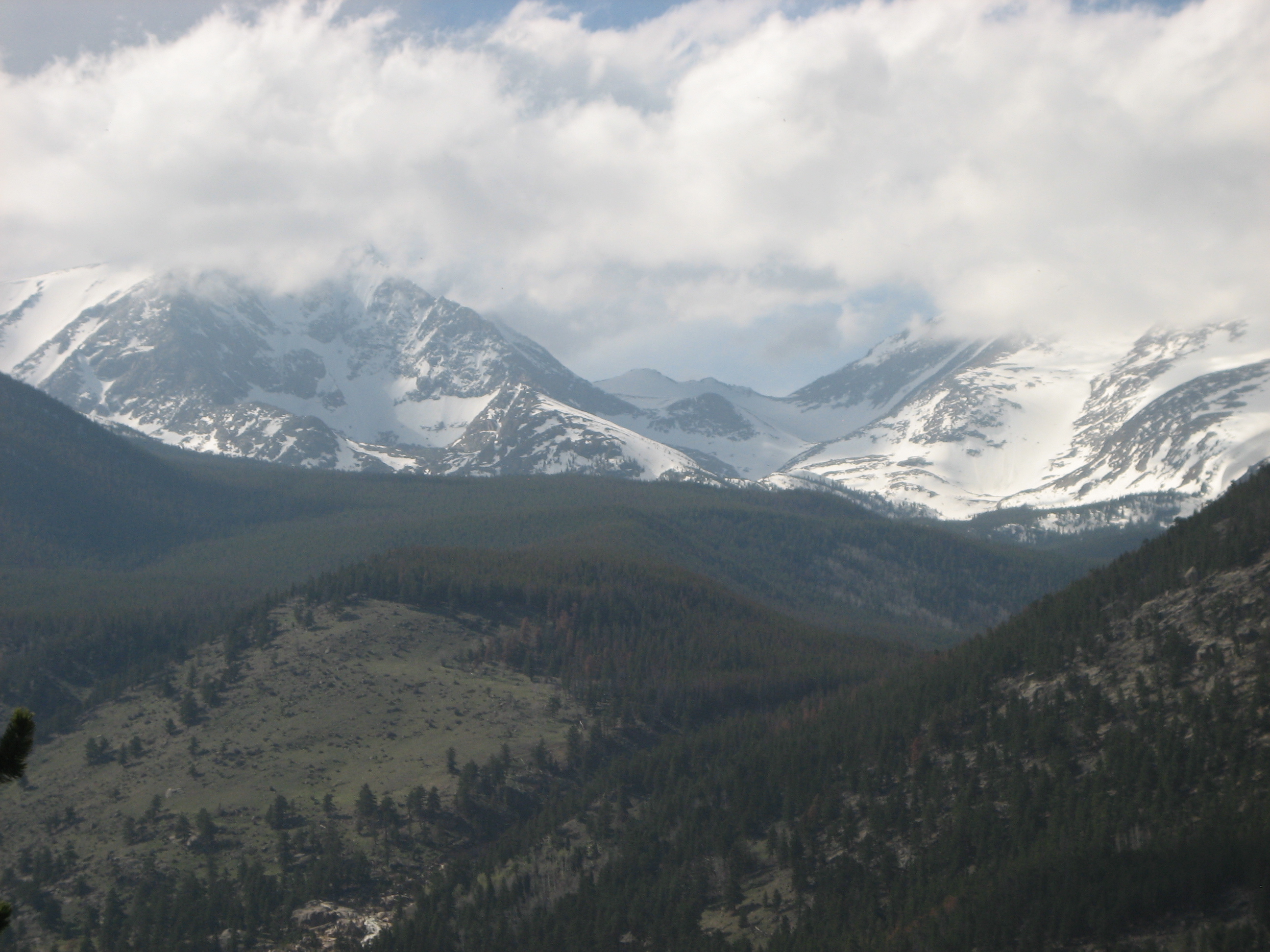
Welcome to my blog.  Here I am, assimilated at last.  gailwritinglife.wordpress.com is now my journal and my online communication with anyone who cares to read it, and I hope you will.  My focus, while mostly on my life here in Estes Park, will also include my work as a writer and my interests as they wax and wane.  I hope to add pictures as they are appropriate, and here’s the first two, one a rather nice shot of the high country in Rocky Mountain National Park I took last summer and the other one I found in the media gallery attached to my blog.  I think even some of the folks I knew in New York City would understand why I’m here.  I’m still learning how to operate this site, which has a great many options to add text, images, links and whatnot.  So expect changes.  Again, welcome.  I look forward to blogging and to your reactions.A picture of the high country from Moraine Avenue, Estes Park