The Things That Got Away

On a prior post, I wrote about trying to edit all my stuff and lighten my Marley’s Ghost style load just a little bit.  Be that as it may, there are possessions, things I owned, that I have, over the years, lost, tossed, given away, sold, or even destroyed that I still miss.  Some of them “got away” because I believed that I no longer wanted them (big mistake!); others because of misfortune; still others are a mystery–I have no idea how they disappeared.  But I still think of them.

One such possession came back to my mind yesterday when I went to a writing group’s member’s house for a lovely lunch she was having for our group (she is an extraordinary cook and we all like to talk, so the whole thing was a delicious treat).  I noticed in her office/study an actual typewriter, a big IBM, I think.  I used to have an IBM proportionally spaced Selectric typewriter, one of the really massive ones, with the whirling typeball and the world’s best keyboard touch.  I can’t remember the exact name of the model, but it was designed to make typewriting look like print, using mylar/carbon ribbons and that wonderful strike.  You could change the typeballs quite easily to change fonts, it had incremental spacing both horizontally and vertically, and it was just the best typewriter ever invented.  I loved that thing and still miss it.  It was, however, huge, and at that time in my life, space was at a premium.  It did not seem sensible to keep a typewriter after I had found the money and the space for a computer and a printer.  It still doesn’t, but that doesn’t stop me missing my beautiful IBM typewriter.  And, of course, at that time, such machines were not dinosaurs, they were still useful.  I got quite a bit of money for it, and that came in handy, too.

English: IBM Selectric II dual Latin/Hebrew Ha...

IBM Selectric Typeball--Image via Wikipedia

When I lived in my California house, I had three genuine Stickley oak rockers.  They had been reupholstered during their lifetimes in a really horrible and prickly green plush (instead of their original leather), but the wood was beautiful and they were comfortable and sturdy.  The Stickley logo, which was actually a brand, was on all three pieces of furniture.  I reupholstered them again, but not in leather, which I could not afford, but in a kind of William Morris-y woven damask that I liked at the time.  When I decided to sell my house and go on my next adventure, for some reason that still passes any possibility of understanding, I not only sold my oak rolltop computer desk (what was I thinking?), but sold at auction those three Stickley rockers (really!  what WAS I thinking???).  I don’t even remember what amount of money I realized from that sale, but it can’t even remotely be equivalent to what they were worth, even reupholstered, let alone what they were worth in intangibles to me, for I had inherited them to start with.   They cannot be replaced, even though there is a Stickley store in Denver, because while the modern stuff is nice, it’s just not the same.  What was I THINKING?

During the clean sweep begun by my decision to sell that house, I disposed of several things that I still think I was right to get rid of, and the money really helped.  But there are still some regrets, such as selling my Fiestaware.  For those that don’t know, Fiestaware is a kind of pottery that is very simple and gets a good deal of its appeal because of the brilliant colors the manufacturers use for the glaze.  I bought my set when Fiestaware came back into prominence in the nineties, and I decided to sell it because the set was in four pastel colors and it was simply too, well, tentative, sort of Fiestaware-lite.  The traditional Fiestaware came in brilliant, deep colors whose very names were delicious, like cobalt, tangerine, maroon, forest and many others.  I don’t regret too much selling the pastels, but I find that I wish I’d bought antique Fiestaware or the new versions of the brilliant and deep colors.  The design is classic and the dishes are functional, sturdy and go with the kind of decor I’m moving toward–mission-y, a little rustic, with touches of older stuff.  My everyday dishes now are white, with a set of red for accent, and I have a small set of Johnson Bros.  Old English Castles.  I’m very fond of this and don’t wish to change, but I still wish I’d stuck with Fiestaware and just gotten more of the deep and bright colors over time.

English: Fiestaware Photo credit: Eric B. Norm...

Fiestaware--Image via Wikipedia

But some losses do not bring minor regret.  Losing my Daddy’s Bibles, well, the experience of that loss is something I will never get over.  I called them Daddy’s Bibles, but one of the small books was a King James Bible and the other was a Treasury of the Sacred Heart, which is, I believe, a Roman Catholic prayer book.  He bought them in Jerusalem during a leave from his work as an Army Major in what was then Persia during World War II.  The books were leather bound, and each had a cover applied to them made of olive wood, incised with a cross.  He was told that the olive wood came from the olive groves on Golgotha, but of course he had no way of knowing if that was so.  The endpapers of both books were inscribed by friends he had met either in Persia or in Jerusalem.  I can remember parts of only one inscription, which was set on the front endpaper of the small prayer book, across from the engraved picture of Jesus Christ showing his Sacred Heart (which is a heart with a perpetual flame on the top of it).  To the best of my memory, it states (partially, I’m afraid):  “Just as this book brought together a Catholic priest, a Protestant man and an Arab boy in _________ [I can’t remember this part, but I think he wrote something like “conversation and understanding”], so may this War bring together all the people of the Earth in a new beginning [I’m also not sure of the “beginning” part, but that was the effect the words had on me].”  It was signed with the appellation “Father”, but I can’t now remember the name of the person signing (or perhaps it was not a very legible signature, as so many aren’t).  Obviously, the person writing the inscription was the Catholic priest, my father was the Protestant man, and who the Arab boy was it is impossible for me to know, but oh I wish I could have heard the conversations the inscription discusses. I would love to (and never will) know what happened and why, and what part that very small book played.  I’m glad to have written down my best memory of the inscription because this is a memory I do not want ever to lose, as I lost those treasured books.

English: Olive Blossoms outside Jerusalem.

Olive Blossoms Outside Jerusalem--Image via Wikipedia

I lost them because I left my husband.  I put them in the duffel bag that held some clothes and the things that I could not part with, even for a little while, that I took with me when I left.  Since I was more or less staying with different friends each night (when I say I left my husband, I mean I walked out the door, with absolutely no plan for the next five minutes, let alone the future), I kept the duffel bag in my car.  Unfortunately it was in the back seat on the one and only time in my life I was robbed.  I didn’t mind losing the clothes or anything else, but losing those books was more than I could bear.  Coming so quickly after the devastation of ending a marriage, the loss of Daddy’s Bibles flattened me and seemed to symbolize all the losses I’d ever had and all the foolish things I’d done to help those losses happen.  It still does.

But let’s end this essay on a somewhat lighter note.  In everybody’s life, there seems to be a kind of black hole, down which household items simply disappear, never to be seen again.  Most of us who have an automatic washer and dryer have one of these black holes, which eats socks (only one of a pair, of course, otherwise we would never know), or the only pillowcase that actually fits that odd but really comfortable pillow.  I have one of those, but I also have a black hole into which books or magazines or notebooks or documents disappear.  For example, I bought, from Dover Publications, a book of houseplans which had originally been commissioned by one of those “shelter” magazines in the 1930s.  The main portion of the book detailed four houses, quite imaginary, commissioned from then-current architects and decorators, to fit certain imaginary pieces of land set theoretically in various places in the country.  I loved reading the descriptions of a bygone era in home architecture and decoration; what the architects and decorators found important and what they didn’t even address; and the four plans were beautiful.  And that book, which I would never have given away, lent, sold or tossed, is simply gone.  When sorting through all my books last spring, I specifically looked for that one and it is just not there.  I have searched through the Dover website, and I can’t find a replacement.  Perhaps I made up the whole thing, but I don’t think so.  I still miss that book.  I’ve also lost, down that same black hole, the only copies of several research papers I was rather proud of, papers I wrote before computers during a student time when I didn’t have the money to get the papers copied (Xerox copies used to cost a lot of money per sheet, like faxes still do) and of course I didn’t use a carbon.  I would like to have those papers again, perhaps because I’d like to revisit that student, that girl, I used to be.  I once created an entire rhetorical system for a class in modern rhetoric I took at CSU.  I cannot remember at all what that system consisted of and I’d like to.  It earned me an A+, so it couldn’t have been really silly.  And I have no memory of what I said in that paper.  None.  Oh well, it’s not like what I wrote was the secret to cold fusion or anything.  At least I don’t think so.

So, even while I attempt to find satisfaction with fewer possessions, there will always be “the stuff that got away.”  Whether because of happenstance, black hole, bad decision or an unforeseen devastating loss, all of us, I believe, have things that were more than things that live now only in memory and the loss of which we mourn.

Shopping

On Monday, my friend Ann and I went to the valley (see my earlier post on the way we Estes people talk) to shop.  Boulder and Longmont, actually.  I had been wondering why, if I had lost (as I have lost), over 55 pounds (at last count) I still looked so, well, bulky?  So, I turned sideways to a mirror after dressing in my best uniform of black knit pants and tunic-length T-shirt and noticed that everything was so loose that I kind of swam inside it.  I looked not only not much thinner but really sloppy.  Hmmmnh.  Although it has been years since I’ve enjoyed shopping (unlike the Wicked Queen‘s, my mirrors have seldom said to me that I’m the fairest of them all), it seemed indicated.  So, off Ann and I trekked, talking all the way about everything and anything from Estes Park politics (always a source of wonderment) to my new more minimal living room (Ann is not yet a fan, and I’m still not sure–see my last post).

English: Daffodils at Longdon Daffodils in the...

Lots of Daffodils--Image via Wikipedia

We had lunch first, and then went to a big and old-fashioned hardware store called, I think, McGuckin’s.  This is a great store, the kind of store where you can find, say, funnels or kitchen tongs just a few aisles away from pretty pots in which to put plants.  It’s not a lumber yard hardware combination, just a real hardware store.  Great fun!

Then, we found that the Macy’s in Boulder is perhaps the only one in the country that doesn’t have a plus-size department.  (I may have lost a lot of weight, but there’s still a lot to go.  Sigh.)  Colorado has the distinction of being statistically the healthiest state in the union, which is probably accounted for by all those residents and visitors in inadequate snow gear hiking up very pointed and steep bits of scenery.  Although I don’t know this for sure (my idea of a hike is from the sofa to the refrigerator), this state apparently has bike races in which the idea is to point the bicycle up the steepest road and/or trail possible and have at it.  In the winter.  Shudder.  Anyway, after that, we went to the upscale mall and a shop called Coldwater Creek.  Which has plus size clothing (at least some).  Of course, this mall in Boulder is not just upscale, but UPSCALE, and has an Anthropologie, a Moosejaw, whatever that is, a Chico’s , a Black/White and, be still my heart, an Apple store.  Ann had to practically physically restrain me from going to the Apple store, because I want an iPad so bad, I’m like a kid at Christmas wanting a Flexible Flyer.  I have no need for an iPad; in fact, I haven’t figured out all the bells and whistles on my iPhone yet; but Steve Jobs got it right, and I simply want it.

But Coldwater Creek distracted me, because I was getting into pants and jeans (jeans!) four sizes below what I had come to think of, with resignation, as “my” size.  FOUR sizes down.  Woo Hoo!  I have to admit, I haven’t felt that kind of joy shopping for clothes for a lot of years.  And the pants I tried on weren’t even “plus” sized, but a regular women’s size.  Quite a rush!  Ann was terrific, finding smaller sizes of everything, and searching for what I wanted.  I finally settled on a pair of red jeans (jeans! me!), a pair of black jeans (ditto!) and a pair of more dressy black knit trousers.  All of which have to be altered because while they fit beautifully, they were all four inches too long.  A very small caveat, and I’ll find someone to hem the trouser legs very quickly.  What a success!

So was our next stop, Whole Foods, which is a store I love.  Blood oranges, Meyer lemons, balsamic roasted beets, quinoa salad, all sorts of yummy, healthy foods, and we were done.  The store was filled with big bouquets of daffodils, such cheerful flowers, and they make me feel happy.  So that’s where I’m going to end today.  The very strange moment we endured later at a Sears store that was closing forever will be for another day’s blog.

I hope all your shopping trips are wonderful ones, filled with funnels and daffodils and the next smaller size!

Yellow daffodils

Daffodils--Image via Wikipedia

Stuff

Marley's ghost, from Charles Dickens: A Christ...

Marley's Ghost - Image via Wikipedia

No-one could possibly accuse me of minimalism.  For a good part of my life, my idea of beautiful home decoration has been shabby chic combined with heavy doses of Victoriana sprinkled over with the contents of a thrift shop.  A very cluttered thrift shop.  Of course the fact that I more or less accumulated my possessions from thrift shops and hand-me-downs, and had little money and probably not much talent to spare for home decoration probably contributed to the general effect.  The last time I was able to move from one house to another with everything I owned in my car (including an ironing board, one of which I no longer possess) was when I left Wyoming and that was so long ago, the main economic problem the United States had was runaway inflation.  I won’t even tell you which president was presiding over that political disaster.  Except he was a Republican.  Just saying . . . .

Since those (obviously not) halcyon days, my household possessions have accumulated to a point that whenever I now move from one house to the next, I feel rather like a domestic version of Marley’s Ghost, dragging sofas and bedsteads and antiques and tchatchkes and pots and pans and paintings and books and books and books behind me.  Or like a snail whose shell is never big enough, requiring a trail of shells stuffed with, well, stuff, behind me.  And each time I move, there is more.  More stuff, more aggravation, more feelings of dragging the world behind me.

I have moved, child and woman, 21 times, not including going back and forth to college, and each time I had more possessions to wrangle.  (A weird tangential connection to this fact occurred to me when I realized that in terms of continuous residence, the place I inhabited longest was an apartment I never really liked in Los Angeles where I lived for eight years.  Even when I was growing up in Estes Park, I lived with my folks for six years and then began college residence, jobs, returning home when the jobs disappeared, and whatnot.)  When I was little, of course, all the family’s possessions were not my problem, although dealing with them seemed to exhilarate my dad and drive my mother into a frenzy.   And wherever we ended up, the decanting of those possessions from the moving truck, the finding of a place for them all to fit (as I recall, we had the largest sofa ever made, although possibly my own size relative to it may be influencing my memory), the hanging of pictures and shelving of books, the filling of the refrigerator, all combined to make what was a strange new box with a roof into our much loved home.  I still feel that way, realizing a great satisfaction when some piece of furniture looks just right in a new alcove in a new house.

I feel now that the process we used when I was a child of making a new space into our home by arranging our things in it was reinforced when my father died and the centerpiece of a loving family became not a person but the things he’d left behind.  I have spent my adulthood dragging things with me because they represented the people I had lost.  It has taken me a long, long time to realize that and to tentatively move toward a sense that the those people are still with me even though things are lost (and some of them have been) or given away (ditto).

Since right now I’m happily ensconced in my pretty house in Estes Park, with no plans or worries about moving, this topic may seem a bit superfluous.  And some, even many, of my things I deeply love.  I am fortunate to have have some real antique furniture (an inherited Eastlake secretary is one of my great treasures, as is a quarter-sawn oak trestle table with hand-carved dolphin legs found at an auction), some gifts given to me over the years that are priceless (a wedding gift of 200-year-old Limoges china is the standout here), and books old and new that are precious to me.  But this year and last, spring or the promise of spring has found me wanting to sort through and discard some pieces out of this huge amount of stuff.  This surprised the heck out of me, but I did it.  I donated over 20 boxes of books to our local library, at least eight huge trash bags stuffed with clothing, linens and other cloth goods to the hospital thrift shop, and furniture, china, silver, glassware, and objets d’art (actually, most of them were more objets than d’art) to the other charity thrift shop in town.  The work was spread over weeks, but it was still quite a process, in which a professional de-clutterer and I dug through cupboards and sorted through books.  After it was done, I no longer had any bookshelves with books double-shelved, my bedroom closet had nothing on the floor except a laundry basket, I could close all the drawers in my house without stuffing the contents back down to get the drawer to fit properly, and I knew where every single one of my possessions was.

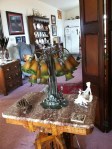
But that doesn’t seem to be enough for me.  Yesterday, the same de-clutterer helped me to weed all the pretty things (some of them not so pretty, when I really looked at them) that festooned every flat surface in my home.  Some, not really a lot, went to the thrift shop, but others are packed away until I can sever the (sometimes deep) emotional connection I have with them.  Or, alternatively, discover that I miss them too much and want them back.  But to give an example, the double pie-crust table in my living room used to hold at least 20 objects, to a point where there was no place to set down a cup of coffee or even see the surface of the wood.  Now, it has a small stack of pretty books, a candy dish, and a coaster.  I’m not used to it yet and it looks quite bare to me, but serene.  I did the same thing with the library table, which now shows off my treasured lily lamp, a bronze sculpture of the clasped hands of Robert Browning and Elizabeth Barrett Browning, and two Lladro figurines, souvenirs of a long-ago Caribbean cruise.  I can see each one of them.  And so can you, as I’ve just discovered how to take pictures on my iPhone (I’m a Luddite about these things) and have uploaded a picture of the piecrust table and the library table for you.  See below.

We filled two big boxes with stuff (and not so incidentally found several Christmas ornaments I’d completely stopped seeing and put them away for next year).

Do I love it yet?  I’m not sure.  Bare counters and tabletops and shelves are not really my style, never have been.  No, I’m not a minimalist.  But the house feels more light and airy, there seem to be places to put things, and I can really see the pretty things I’ve got out.  Of course, with fewer things hiding the surfaces or fooling the eye, my old chairs and sofa look a lot more shabby chic than I actually intended, but after all there’s always a snake in paradise.

An Exploration of Sloth

Jacques Callot, The Seven Deadly Sins - Sloth

Sloth -- image by Wikipedia

As I was reluctantly dragging myself out of bed this morning (ahem, actually, this afternoon), I realized that while I don’t spend much time thinking about the seven deadly sins (which, if I remember, include envy, avarice, gluttony, lust, sloth, pride and one other, obviously I need to LOOK THIS UP) and, to a lesser extent, the seven cardinal virtues (of which I remember not even one), I would have to admit that of them all, sloth seems to be my most besetting sin at this point.

Of course, it’s an interesting concept anyway, the idea of sin or virtue.  There are a lot of differences (and a lot of similarities) among the living beings on this planet, but I don’t think any other species than us, human beings, require an operator’s manual (in other words, a religious text, a set of laws, a constitution, an etiquette book).  Other living beings seem to come with a set of instructions that keep them acting according to their best natures at all times.  (No, Virginia, a tiger’s best nature is to stalk and kill prey, it is not being “evil”.)  But we, whether because of our relatively big brains or because we are social animals that operate less by instinct than others, seem to be unable to live in this world without a rule book.  And whatever the rule book we choose, there are certain basics that we seem to have to be continually told not to do — thus, in my cultural and religious background, comes a concept of sin that keeps us from naturally behaving according to our better natures and without requiring that the rules be continually drummed into our heads.  In the Western Christian tradition, there are other greater sins, but the seven deadlies are the everyday sins that, as human beings, we are inclined to commit.

So, today, I’m thinking about sloth.  I don’t normally think of myself in terms of sin and redemption, although there are those people who probably think I should.  But sloth is easy.  I am slothful.  I am not one of those fidgeters who cannot sit still.  I can sit still for a very long period of time without even noticing it.  I am one with the person that originally said “do not stand if you can sit, do not sit if you can lie down.”  I think it’s great advice.  I find it restful and I find fidgeters highly irritating.  I keep wanting to tell them sit down and shut up.  Although I don’t.  (Being irritated irrationally and showing it may not be a sin but perhaps it should be.)  So, it’s a pejorative word, sloth, sounding as sinful as almost all churches, schools, businesses and governments think it is, and thus I need to refresh myself on the rules and get up and at ’em, and DO something.

But, being human, I’m thinking about these seven deadly sins, or at least sloth, in a slightly different fashion today.  What the heck is so sinful, anyway, about sloth?  It is quiet, after all, and apart from irritating busy people, doesn’t really hurt anyone.  And to my way of thinking, there’s a great deal too much busy-ness in the world anyway.  If we all dialed it back a bit and stopped running around like crazy people, perhaps the world would slow down and we could actually catch our breath and figure out what’s going on.  Or so it seems from the perspective of my sofa.

In reality, I do know why sloth is a sin, or considered so.  For the vast majority of our history, a slothful person would either, because of it, die of starvation or in the jaws of a much less slothful beast or, more important to the society, cause the tribe to be less prosperous, less happy, and put the tribe, especially the more helpless members, in greater jeopardy.  Later on, as civilization (and all its discontents) got started, sloth interfered with the creation of wealth.  And that’s from both perspectives.  If you were a landowner, say, your industry and work ethic, your constant busy-ness, would help you increase your holdings, increase your crop yields, give you more clout in your village, town or city.  From the point of view of one of your laborers, you would need to work constantly and diligently, or you would starve, be beaten, be driven off or even killed because you were a liability and not an asset.  As cultural institutions got started, all their wealth and thus continued existence was based on that diligent labor growing ever larger yields since (either through tax or through tithe) all had to contribute to them.  So of course, as a government, church, or business, you would institutionalize the work ethic and the fundamental idea that sloth is a sin.  And, for the development and continued growth of civilization and of wealth, it is.

And I have to (reluctantly) agree.  Nothing comes to any of us without some kind of mental, emotional, spiritual or physical effort.  Sitting on my sofa is pleasant, but the fact that I have a sofa in the first place is due to effort I expended in the past to earn the money for the sofa and to find, choose, buy and have it delivered.  Of course, we all know or know of people whose wealth is hereditary, but let’s face it, somebody had to expend the effort to gain that wealth sometime and, for that matter, a life of such ease in which one does literally nothing is not really a life at all.  And I think quite impossible.  If done right, a rich person’s life of leisure can be spent studying, learning new things (quite a few scientists and explorers in other centuries had private means and did not have to labor to earn the money for expeditions or the time to think), supporting art and artists (or engaging in art and artistry), creating gardens or museums or donating to and working for hospitals and universities.  In my small town, many retired people, if not most of them, or people who have wealth who come here to live, end up working for nonprofits, taking part in the artistic and cultural life of the community, doing volunteer work in many different fields.  At least one retired person of my acquaintance hikes every day and picks up litter to recycle or dispose of as they do so.  That is NOT nothing, by any means, it is part of the rent we pay for our space on the planet.

But I have to admit that fairly recent anthropological studies have reported, after research including today’s hunter-gatherer tribes (and most anthropological thought seems to agree that human beings began our still short run as hunter-gatherers), that even in today’s more constricted world, hunter-gatherers need to work only about 20 hours per week to “make a living.”  That is, in order to hunt, kill, dress, cook and eat the meat from the animals they hunt, and to search out and find the grubs, insects, roots, leaves, fruits and whatnot actually forming the majority of their diet, plus all preparation, takes only about 20 hours per tribe member per week.  And these people are apparently not bored with all that leisure, either, inventing songs and dances and enjoying each other’s company, raising children, listening to tribal history from the elders.  (Current thought says that to maintain this rather idyllic society, there are some drastic measures that are taken by the tribe, including shaming of exceptional performance, discouragement of any private property and maintaining a very small population.)  Some of this sounds good to me (although other parts don’t), and I do wonder for such reasons (and for others such as the inevitable, it seems, rise of treating other people as property) why in the world we ever did something so silly as to invent agriculture.  From the pre-historic traces and the historical record, we were as individuals and as a species healthier, had better teeth, lived longer, and had a much more pleasant life before we started all this growing of food and herding of animals. Agriculture, it seems, provides calories to larger numbers of people in a small area without, apparently, providing the trace minerals, vitamins, and whatnot we need for full health.

NOTE:  Re-reading the above, I would like to firmly state that I am not making any kind of comment on current political views.  If I can manage to do so (although in an election year it may be difficult), I would like to keep this blog clear of my (or other people’s) politics, primarily in my own case because I seem to arrive at my hopefully middle of the road views by a series of rather illogical jumps from side to side.  The above paragraph comes from reading recent research into the pre-history of our species.  I have always loved history and the study of the origins of our world’s civilizations fascinates me.

I’d love to continue to explore how humanity got started on this road, what its benefits (and civilization does have them; for example, probably a hunter-gatherer society would not have invented the computer) and liabilities (working for others for low pay and bad food seems to top that list) are, but right now I’m too slothful.  That sofa is looking very good.

Oh, by the way, a wise person, possibly Mark Twain or more likely my friend Sharon Goldstein, once said that if you are doing what you love, you’ll never work a day in your life.  And here, to finish this post, is a picture of a being who is exceedingly good at sloth, because he IS a sloth.

Bradypus variegatus Deutsch: Drei-Finger-Fault...

Central American Sloth - fromWikipedia

The Sunday Paper

So many sources, both on the web and off, tell me that newspapers are moribund if not already dead.  Except maybe for the New York Times (which I, in a fit of irony, get on my iPhone).  My response is somewhat like Chuck Heston’s about the NRA, they’ll have to pry the daily paper from my cold, dead hands.  Practically the first thing I did after I moved here, even before I got all the dishes unpacked, was to call the Denver Post and get a subscription.  My day doesn’t really start until I retrieve the paper (which is usually, alas, at the bottom of my very steep driveway, or in the bushes to the side), separate it into sections I will read and sections I won’t, and sit down with some breakfast (or lunch–after all, I’m retired and don’t have to get up at a specific time) and read.  I’m quite conscientious and read the national section and the state section first before I go to the funnies and the puzzles and the agony columns.  But on Sunday, it’s really fun — there are two magazine sections (neither, unfortunately, published as they used to be by the paper itself), a big Arts and Entertainment section which includes book reviews and a travel section, an op-ed section, and so forth.  Lots of reading, plus a New York Times crossword which, I have to admit, normally defeats me.  The Post is quite generous about putting the answers on the same page, so if I just have to . . . .

Because this is, after all, Colorado, the Post also has, during the fall, a separate insert about the Denver Broncos every week, sometimes more than once a week, but always on the day after the game, whatever game it is.   If it’s a “big” game, there’ll also be an insert on game day.  Some of the best columnists working for the Denver Post handle sports, and it has been such a ride this fall with “Tebowmania”, I’ve really enjoyed reading their take on the phenomenon.  Living in Colorado requires being a Bronco fan.  Nobody seems really sure of this, but I think there’s something in the State constitution.  Either that, or in the water, that simply makes it happen.  There is a huge sculpture, brilliant blue with orange eyes, of a rearing horse outside DIA.  I wonder how many visitors to the state ever realize what that sculpture signifies?  More than anything else, it signifies how rabidly fond of their Broncos Coloradans are (although we have a tendency to like them better when they’re winning, no matter how sloppily).  Ooops, getting a little distracted here.  Back to newspapers.

English: Denver Post building in Denver, Colorado.

The Denver Post Building, image by Wikipedia

I dread the time that newspapers disappear.  When I lived in Los Angeles, I perforce got the Los Angeles Times, which is (horrors!) still my standard for a good newspaper.  They still have a weekly magazine, called “Calendar,” I believe.  And a lot of comics.  And I miss that.  In New York, I had a subscription to the New York Daily News, because the New York Times doesn’t have agony columns or comics.  I still have no idea what their editorial board is thinking.  Don’t they want anybody to read their paper?  In any event, I found I enjoyed tabloid journalism, done New York style, and, after all, I never sank so low as to subscribe to, or even read, the New York Post.

Historically, the first newspaper published, or at least the first one that lasted, in Denver was the Rocky Mountain News, which was the morning paper.  Like the New York Daily News, it was tabloid sized and had lots of comics for little kids like me and lots of columns for grown-ups like my folks.  The Denver Post, which started later, was the evening paper.  I believe, without really knowing, that the Post attempted to be a “record” for the state in the way that the Washington Post tried (and tries) to be for the country.  But my memory of the Post during my years in Colorado was mostly that it was amazingly biased, although I actually can’t remember in  what political direction.  When I moved to California and was told that the Los Angeles Times was editorially biased, I had to laugh, because the LA Times was so much more careful in its punditry than the Post ever was.  A few years ago, when the first wave of newspapers dying off was rampant through the country, the Rocky Mountain News more or less disappeared into the Denver Post, which became the morning paper.  A lot of folks were unhappy about that, including me, although I wasn’t living in Colorado at the time.

Of course, the news on the front page is a little dated by the time it’s published — most of us, including me, get our actual news from the TV or the Internet, which by their nature can get breaking stories to us much faster, but I still find that the newspaper articles seem more reasoned and nuanced than what I hear on the tube (which is a nickname for TV that has recently become completely out of date; pretty soon, people won’t understand where that name for it came from (ditto “the box”, for that matter)).

But it is such a lovely and quiet way of reading about what’s happening, much nicer than having it drummed in one’s ear.  And, after all, if newspapers last long enough, someday I may actually be able to complete the New York Times crossword without having to look at the answers.

Swimming at the “Y”

English: Administration Building at YMCA of th...

YMCA of the Rockies Administration Building, image from Wikipedia

The Estes Park Center of the YMCA of the Rockies has 860 acres of mountains nestled beneath Longs Peak.  Most of the land is pristine, with only hiking trails to show human presence.  The vast majority of the buildings, which include lodges and eating facilities, cabins, a theater, administration facilities, a “longhouse” (a roofed enclosure that provides walking and running space during winter months), various craft buildings and an indoor swimming pool, are clustered around a high mountain meadow — the altitude is 8,010 feet.  It is one of the crown jewels of the YMCA system, which has been visited by quite a few of the 20th Century Presidents of the United States, European diplomats, and (most important) ordinary families looking for realistically priced accommodations, lots of outdoor activities and good inexpensive food.  It must sound a bit as if I’m shilling for them, but I’m truly not.  I’m simply a member, entitled for a fairly reasonable membership cost to swim year round in their very large indoor swimming pool.

Swimming is my favorite exercise.  I’m not exactly clumsy but I’m not exactly not clumsy either and walking or hiking on uneven ground scares me.  After several serious falls in the last few years, my fear of falling has grown.  But if you’re in a swimming pool, how can you fall?  I can push harder, either walking laps or swimming them, and not worry so much about such accidents.  Much more than that, I have always hated sweating.  I know that sounds stupidly girly-girl of me, but there it is.  Sweating itches, attracts dust, makes you filthy and messes up your hair.  Contrary to propaganda, women do not glow (except possibly Rita Hayworth, of whom this was said by her then husband Orson Welles).  Women perspire and some women, like me, sweat.  In a swimming pool, my hair is already messed up and wet, there is no dust, and if I’m sweating, how can anybody, even me, ever tell?  And finally, instead of finishing a hike and then having to come in, shower and change in order to go out for errands or simply being with others in the world, after finishing a swim, I’m right there with a locker/shower room and my clothes packed up and ready for me.  A shower, towel-dry my (very short) hair, get dressed and I’m ready for anything, oxygenated, invigorated and clean.  Because the Y’s pool is heated and indoors, I can exercise and enjoy myself any day of the year without reference to Estes Park’s high winds or snowstorms or cold.  Water temperature is kept at about 85 degrees and the temperatures in the locker rooms are just about that, so it’s a pleasure on a cold, blustery day to come in to the pool building and strip down to my bathing suit, not a penance.  The pool is big.  It has one area over ten feet deep, but most of it is no deeper than five feet, with the shallow end at about three feet, making it ideal for families to play in the water with their children.  It is also easily divided into lanes for lap swimmers.

Estes Park has a municipal indoor swimming pool, but it costs more than the one at the Y and its hours are much more limited, because the municipal pool is used by the school district for swimming lessons and meets with other schools.  (Our high school swim teams compete at a fairly high level, on the whole, for such a small school.)  So, if you want to swim at the municipal pool, be prepared to get there at 11:30 and swim fast, because open swim is over at 12:30.  At the Y, open swim takes place each day from 12:30 to 5:00 and from 6:00 to 8:00 p.m.  There are also classes and there’s lap swim times as well.  I really do sound now like I’m advertising for them, don’t I?

But, although we have a fitness center in town and it wouldn’t hurt me at all to join and do some weight training, the reality is that if the swimming pool out at the Y didn’t exist, I would turn into a slug in the winter.  It is too cold and windy for an indoor girl like me to enjoy walking or hiking outside (I’ve always had the strong feeling that the outdoors is a wonderful place to look at), and (as said above) I don’t like to sweat.  Walking or swimming through the water exercises the muscles of my arms as well as my legs and torso, gives me an aerobic workout, and, if I use some of the water toys the Y has available, I can even get in some resistance exercises.  It’s also wonderful for a person like me who has excess weight still to lose and who isn’t as limber as she used to be, because in the water it is easy and safe to stretch and extend legs and arms, bend backwards or sideways and in all ways loosen and limber one’s body.

And that’s not all.  Walking or hiking can be quite solitary, which is, of course, one of their charms in such a beautiful place.  And so it can be at the swimming pool.  There are times in winter when I’m the only person in the pool, which can be really enjoyable:  quiet, peaceful and it’s all my space for the time I’m there, to swim, cavort, tread water, float, do what I like.  But mostly there’s always someone there (besides the lifeguards, of course, who are always there and have always been pleasant to talk to, although I’m sure they find my walking (or swimming) up and down a little boring).  Sometimes it’s an elderly couple, walking back and forth, enjoying the water and the use of their limbs just as I am, and we’ll chat and exchange stories.  Other times, and more often, are whole families, with mama holding the baby (festooned with a life jacket, one of the rules) and introducing it to the water, and the older kids splashing and shrieking around daddy, who’s got one of the water toys and is throwing it back and forth to his kids.  Get a larger family group and there’ll inevitably be a game of keep away or of Marco Polo.  I can’t quite see the point of this  game, since from an outsider’s perspective it seems to consist only of one person yelling “Marco” and somebody else yelling “Polo”.  I’m sure that’s not all there is to it, but close observation seems to indicate very little more.  The swimming pool staff have stretched strings of banners over the pool at two points, in both shallower and deeper water, so when a group of high school age kids come swimming, there is suddenly (and always) a game of volleyball, which is usually a lot of fun to watch.

As I plow my way through the people enjoying the pool, I have been head butted by a toddler, backed into by a three giggly girls at a time, and nearly flattened by somebody diving into the pool (that time, the lifeguards were there in a heartbeat, because diving is strictly forbidden–some boy will either not know or figure the rule doesn’t apply to him, but that happens only once, the lifeguards are quite strict).  Sometimes the lifeguards will play some (very loud ) music, and if there are people in the pool having fun, of course their voices echo in the big building.  I duck under the water for some momentary peace and quiet.  But mostly it’s a lot of fun watching people enjoy themselves.  Sometimes I’m asked to take part for a little while in a game of pass the ball in a circle, which is about my speed.  Nobody has asked me yet to take part in a volleyball game or in a game of keepaway and I’m just as well pleased.  So it’s not just necessary exercise, it’s a fun thing to to do.  And it always lifts my spirits.

If I’m fairly alone in the pool, it’s a great time to simply be.  There are windows along each wall looking out at the mountains, with Longs Peak a sentinel over all.  There are trees outside and often animals, elk, marmots, whatnot, ever changing.  I get my zen on, and can stay in the moment (always hard for me to do) better while swimming than in any other place or situation.  Or alternatively, it’s a good time to ponder an issue, plan a future, dream a dream.

Maybe if I’d been able to get out there to swim the last couple of days, I would have been better able to write a post for this blog this past Thursday and Friday.  I could not seem to get started these last two days, and I thought my beginner’s luck at writing this blog had run out and I was hosed.  So, yet another plus for swimming!

Part of my view as I drive out to the Y is given here in a picture I took last summer.

RMNP from Moraine Avenue

Estes Park Talk

We got to the Stanley Hotel around noon on Sat...

The Stanley Hotel (from Wikipedia)

It occurs to me that some definitions may be in order.  As in a great many places, those who live in Estes Park have their own way of saying things.  Since everyone here, including the elk, came here from somewhere else, we are possibly even more fiercely partisan about our town than people are who have been born in theirs.  So here are a few names and definitions:

Estes — What we call our town when we’re not being formal.  As in, to a summer resident:  “When did you get back to Estes?”

ParkRocky Mountain National Park, for which Estes is one of two primary gateways.  Sample statement:  “Let’s take a drive around the Park.”  Also called “Rocky” or, less often, “RMNP.”  I also call it “my big back yard.”  To see a map, please Google maps and specify “RMNP.”

Around the Park — Does not mean literally “around the Park,” which would be a very long hike.  Instead, it means a paved road of about eight or so miles from the Moraine Park entrance up to Deer Ridge Junction, then back down to the Fall River entrance.  Sometimes, this includes a side journey to Bear Lake.  Takes about a half hour, unless you stop and watch the elk cavort or happen to spy a bighorn sheep.

Locals — People who live for either part of the year or all year in the Estes valley.  Sometimes includes residents of Glen Haven (a small mountain community down a picturesque canyon), but does not include residents of Allenspark (a small mountain community up a very picturesque drive called the Peak to Peak Highway, otherwise known as Highway 7).  (Allenspark residents have a beautiful town and are very proud of it.  Also, by definition they do not live in the Estes valley (see below).)  Also a local restaurant.

Elkjam — Local term for the traffic jam that happens instantaneously whenever a car (all right, its occupants) spies an elk or an elk herd close to the road or crossing the road.  That car stops to take pictures and immediately, as if by magic, at least 25 other cars also stop, often in the road rather than on the verge, to take pictures of the elk doing what they do, which is mostly eat and stop traffic.  Those interested in seeing this (locals get very tired of it, actually, not the elk but the cars) should search for “elkjam” on YouTube.  There is at least one news feature about the phenomenon nearly every year.

Estes valley — What residents call the entire valley enclosed by mountains which encompasses Estes Park, with the continental divide to the West, Lumpy Ridge to the north, and lower mountains leading down to the valley.  As a local, I stake my claim that this is the most beautiful mountain valley on earth.

Valley — Term used by all locals (see above) and other mountain people to refer to the area of the United States between the Rocky Mountains and the Appalachian Mountains.  As in, “I’m going to the valley to shop today.”  (In this case, the speaker actually means Ft. Collins, Loveland, Longmont, Boulder or, less likely, Denver.)

The Stanley — The Stanley  Hotel, built by F.O. Stanley (of Stanley Steamer fame) in the early 20th Century as a resort hotel in NeoColonial style.  In order to build it, Mr. Stanley also had to create a hydroelectric plant, a sewage plant and a sawmill.  He also had to greatly improve the roads up to Estes Park from the valley (see above) so they could be used by his own Stanley Steamers to bring tourists to his hotel.  In doing so, he practically created the modern town of Estes Park and its primary industry, tourism.  The Stanley Hotel was a primary inspiration for Stephen King’s novel “The Shining” and his own television production “The Shining” was shot on location there.  It is most definitely haunted.  A picture of the Stanley is at the top of this post.

Fairgrounds — Actually and precisely, Stanley Park, which contains the arena, quite a few horse barns, and space for tents, booths, and so forth.  This is the venue for many summer activities, including the Rooftop Rodeo, the Hunter-Jumper show, the Scottish-Irish Heritage Festival and others.  Called the “fairgrounds” only by locals (see above), thus confusing all visitors because all the signs say “Stanley Park.”

The Bypass — Another confusing term.  Locals call this road the bypass because it does that, i.e., it bypasses downtown Estes Park.  All the signs, however, say Wonderview Avenue.  Which it also is; i.e., a wondrous view.

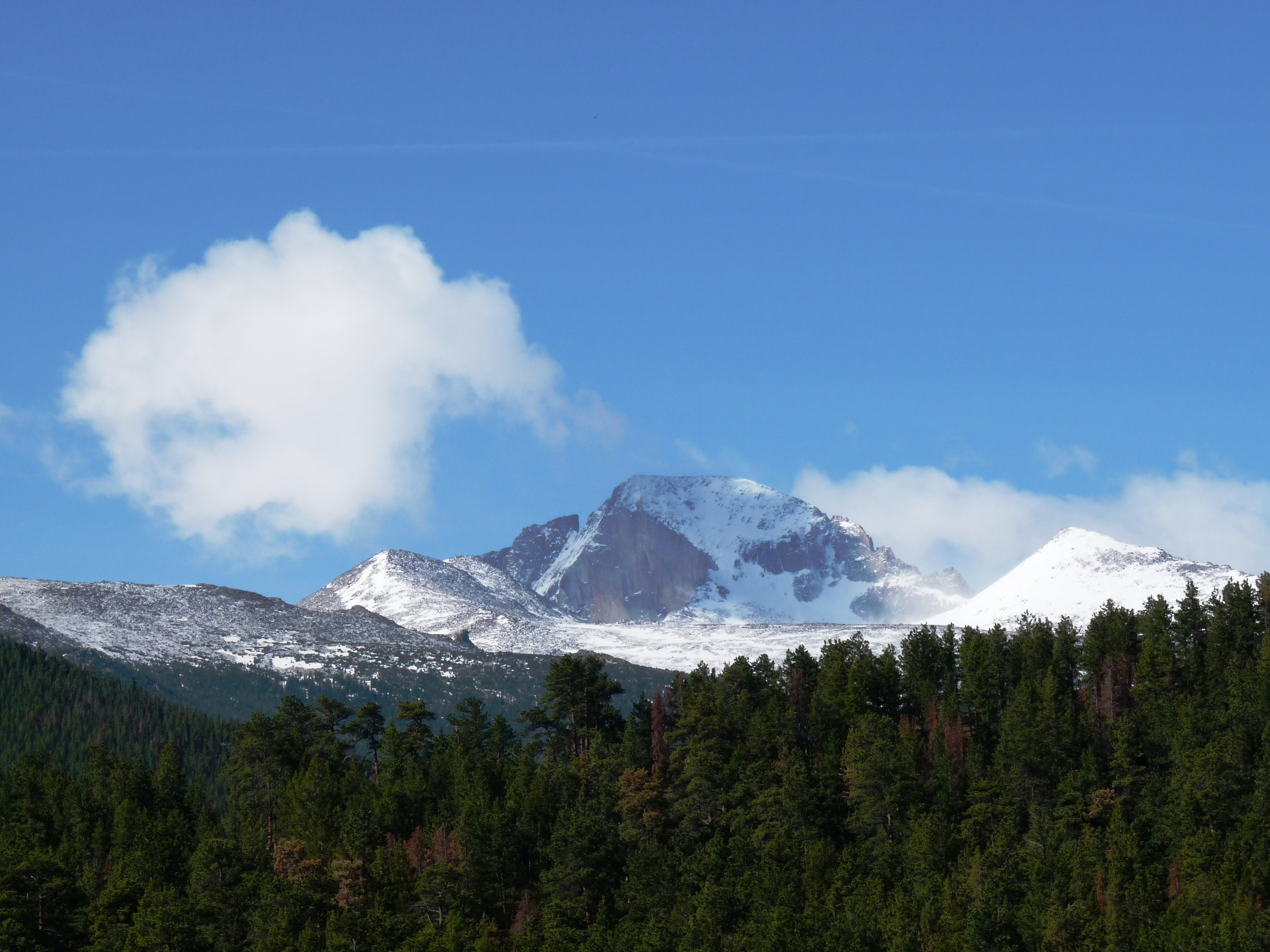
Longs — Local term for our tallest and most prominent mountain peak, Long’s Peak, discovered by an Army gentleman named, oddly enough, Long.  Of course, “discovered” is a relative term, since the Arapaho and Shoshoni tribes always knew it was there.  “Longs” is not to be confused with “Pikes”, which is another famous Colorado mountain peak west of Colorado Springs.  Longs, by the way, is several hundred feet higher than Pikes.  Sample statement:  “Are you planning on climbing Longs this year?”  (My answer is an immediate “no, I plan on looking at Longs this year,” as it always is.)  One of my own photos of Longs is published at the bottom of this post.

Elkhorn — Our main street, named (probably) for the Elkhorn Lodge, one of our oldest still-standing structures, a resort, tourist lodge and dude ranch that is now considered one of the six most endangered historical structures in the state of Colorado.  It should be noted that elk actually do not have horns, they have antlers.  Antlers are shed each year, while horns (see bighorn sheep, above) are permanent and grow incrementally each year.

Dunraven — Now primarily an exceedingly good and long-lived Italian (and seafood) restaurant out on Moraine.  However, in the 19th Century, the Earl of Dunraven (yes, a real British (okay, Welsh, I think) belted earl and no, I don’t know why earls would be more belted than, say, barons or even bankers), falling in love (as so many have since) with the Estes valley, decided ownership was the only possible course.  He spent years more or less bribing more or less unsavory types to “homestead,” after which he would buy the homesteaded land.  Theoretically at that time, one was only allowed to homestead 160 (I’m not looking this stuff up, so anybody out there reading this who begs to differ is probably right and I would love to hear the, well, facts) acres of government land, which the Estes valley was considered to be.  He planned on making the place his own private hunting reserve and to this end built a hotel, the first in town, I believe, for his friends.  (He also, with his friends and with the help of other tourists and hunters, killed off all the local elk population.  The big elk herds that have taken over the town now were originally imported in the 20th Century from Wyoming.)  The State of Colorado and the United States Government took issue with his version of “homesteading” and worked in the courts to break up his holdings, finally managing to annoy him enough that he left, never to return.  F.O. Stanley (above) bought quite a bit of his land for the Stanley Hotel.  However, statements that the Earl of Dunraven haunts the third floor are a bit strange, since the Earl left Estes years before the hotel was built.

Long's Peak

Snow Day

Snuggle time, making soup time, looking out at the world and being glad you’re inside time.  Obviously, I’m an indoor girl.  Didn’t used to be — of course, once dressed in snowpants, boots, mittens, sweaters, parka, hood, about the only thing I could do outside during or after a snow was to make snow angels, and then I could hardly get back up.  But I loved to look up and try to catch snowflakes in my mouth, let them melt on my tongue.  Such a clear, cold taste.

Snow crystals 2b

Image via Wikipedia

And after the snow, when it would get cold and crisp, walking on the snow made a scrunching sound unlike any other sound I’ve ever heard.  I was a child in Greeley, Colorado, and often after a snow would come a hard freeze which would leave a crust on the snow that, at the time, I was small enough to walk on if I was careful.  I would try for the longest series of steps possible before breaking through the snow crust.  Of course, I eventually would, and that usually would mean I would fall down, but falling down on a foot of snow when you’re eight years old and washing your face with snow is fun, not any kind of problem.

But as I grew up, snow got to be a problem at times.  Sometimes more than a problem.  How was it that it always snowed on Sunday night, thus making sleep impossible because I would worry so over the commute to work?  Especially the first snow.  It is a tradition in Denver, it seems, to have a first snow in October.  Coloradans and Denverites are never ready for it and seem to have forgotten how to drive in the stuff over the summer.  The first commute during the first snow was an adventure in terror, pretty much every year.  Sliding sideways down a hill toward a red traffic light on the bottom, realizing dully that the light would still be red when your car slide not to it but through it, now that’s an experience I wish I had missed.

I lived in Wyoming once and tried to transport props for a play I was directing from Rock Springs to Green River on the interstate on a late fall Sunday.  A truly Wyoming blizzard blew up and suddenly my car was spinning just like a top in the middle of the road.  The car behind me could not avoid my inadvertent ballerina move and both cars embraced with a clang.  A couple more joined our intricate (and frightening) dance before all of us fetched up against the rocks to the side of the road, where we stayed for over three hours before the Highway Patrol could sort us out.  Freezing, terrifying, snow.  Driving in the stuff has, since then, been an issue.  It is always a problem when your mortality rises up and slaps you.  When I moved back to Estes Park, I deliberately chose to buy an AWD vehicle, a  Nissan Murano (wonderful car), that ameliorates the problem and my concern at least a little.  But there are times even Tina (originally named “Tiny” ironically for her rather substantial size, but she didn’t seem to like it, so “Tina” it is) can’t get her tires under her and slips rather than glides through the white stuff.

When I lived in New York, I was rather surprised at the relative paucity of snow, at least while I lived there (they seem to have made up for it by now).  The difference seemed to be that any snow they got just stuck around until spring.  In the West, the wind whips the snow around so much that locals say that snow doesn’t melt, it just gets wore out.  So it was always fun to try to get from (plowed) sidewalk to (plowed) roadway with the piled up snow having turned to ice in between.  Twisted ankle heaven.  I didn’t have a car then, but I did have to get into the city to work, so while the subway didn’t slip and slide (at least not for that reason), the bus I used to get to the subway certainly did.

So, when I moved back to Estes, it was with the implicit realization and blessing that now if the snow was just too slippery out there, I could stay in here, free from the necessity to brave the elements, twist my ankles, fall down or slide through traffic lights.   Instead, now I could smugly look out at the beauty of the snow with an unambiguous heart.   (Sort of.  Today is also chore day, trash must be put out to be picked up tomorrow, and my driveway is so steep it often feels, especially when it is wet or icy, as if it had been constructed at a 45 degree angle.  Sigh.)

But that’s done now, and the soup is on, making the house fragrant.  Here’s hoping that your next snow day, if such you have, allows you to stay inside and make soup and enjoy the warmth and contrast with the out-of-doors or, if you’d rather, go out and make snow angels and taste snowflakes.  Just stay off the highways.  Those red traffic lights are traps on a snow day.